
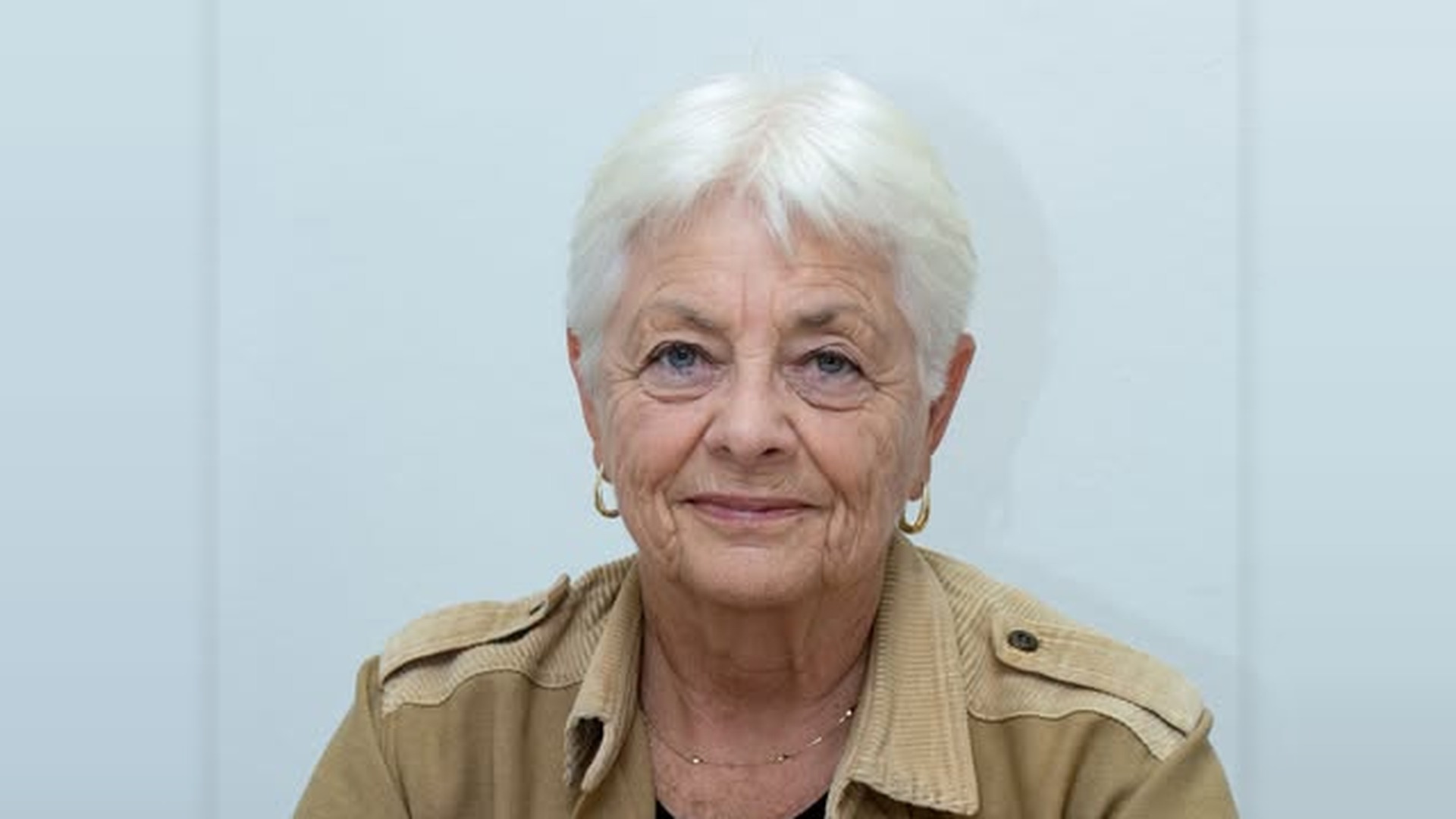
When asked how she became a leader in Israel’s feminist movement, Prof. Esther Hertzog explains that gender issues were the one constant in the long and winding road of her career.
“All my academic studies took place at the Hebrew University of Jerusalem,” she says. “History and philosophy for my B.A.; education and social Work for my M.A.; and a Ph.D. in social anthropology, along with a teaching certificate. Shortly after I married Avraham Hertzog, we went on a shlichut (emissary posting) to South Africa, where we spent three years.”
Back in Israel, she gave birth to four sons, worked as a cultural coordinator at an absorption center in Michmoret, and then became head of the education department of Or Akiva. A few years later, she worked with JDC Israel to co-found a nonprofit in partnership with the Ministry of Labor and Welfare.
“The project trained women as paraprofessional workers in the ministry’s social services,” Hertzog explains. “Following this experience, I decided to write my Ph.D. thesis on the integration of immigrants from Ethiopia. I was privileged to have the late Prof. Emanuel Marx as my supervisor. With support from JDC Israel, I carried out fieldwork in an absorption center inhabited by immigrants from Ethiopia. For one year, I lived with my two-year-old son in a caravan in the Or Akiva absorption center, which housed about 200 immigrants.”
During her nearly twenty-six-year tenure at Beit Berl College, she published a monograph on the bureaucratic absorption of immigrants from Ethiopia, another on women in rural Nepal, and an edited volume and numerous articles on women in the Holocaust. For over three decades, she also headed Shin, the Israeli movement she co-founded for the equal representation of women. To bring her ideas about feminism to the wider public, she penned a column on gender and other social issues for Maariv and Ynet (Yedioth Ahronoth).
In 2017, Pres. Yecheskel Taler of Zefat Academic College (ZAC) asked her whether she would like to teach in the Behavioral Sciences Department. “I had given a lecture at the college a few years earlier, and he remembered me,” Hertzog says. “He appreciated my interest in marginalized populations and Israel’s periphery, and I gladly accepted the invitation.”
Since joining the department’s faculty, Hertzog has worked with colleagues in the department and across the college to organize numerous conferences on gender, including a now-annual conference on violence against women, as well as conferences on trafficking in women and on women’s political leadership. In each case, the first day is held in English on Zoom, to allow for international speakers; the second day is held in Hebrew and is intended for ZAC students. “The goal is twofold,” Hertzog says. “First, to enable researchers throughout the world to gain knowledge and perspectives that they can take back to their home communities. And second, to empower ZAC students to become bridges between theory and action in the Galilee.”
As an example, Hertzog describes two students who presented at this year’s conference, on gender and health in the periphery. “These students had undergone fertility treatments and spoke about how much more difficult the experience is for women in underserved areas,” she says. “Not all services are available in local medical centers, the infrastructure makes travel difficult, and many healthcare providers aren’t versed in the sensitivities of the communities they serve. If health outcomes and access to healthcare are worse for residents of Israel’s periphery, they are all the more so for the women among them, Jewish and Arab alike.”
To translate this awareness into action, Hertzog and the devoted team working with her plan to establish a Center on Women and Health at ZAC. Alongside academic research, the center will offer training, lectures, and expert consultation for regional doctors and nurses. ZAC is interested in developing a foundation for this research-to-impact approach: student “health liaisons” in the Arab community who can speak in informal settings in their villages about available health services, preventive medicine, and agency.
“Since health is the basis for a flourishing life, advancing health equity for women, led by women, in the Galilee is critical,” Hertzog says. “It’s a key part of closing the gap between Israel’s center and periphery.”