
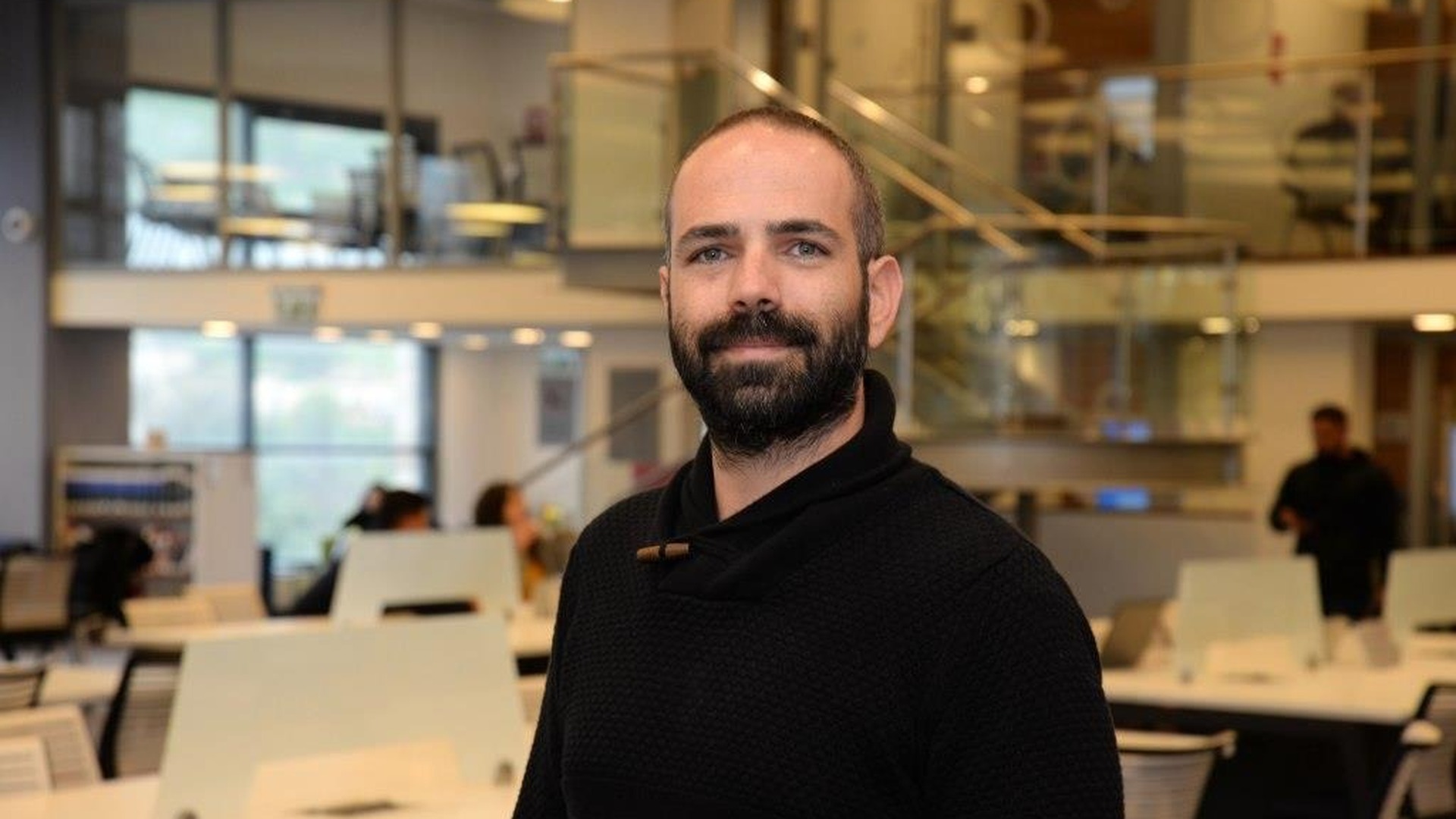
Dr. Yitzhak Ben Yair believes in second chances. One of Israel’s leading experts on teaching forgiveness, the senior lecturer in criminology at Zefat Academic College (ZAC) also developed a pioneering model for enhancing the rehabilitation of offenders through the study of classic Jewish texts. Yet Ben Yair doesn’t need research to show the power of education to remake lives. As he’s more than happy to point out, he himself is living proof.
“I wasn’t what you’d call a ‘student’ growing up,” says Ben Yair, who explains that he didn’t finish high school with a matriculation certificate. And for a while, it didn’t seem to matter: After completing his army service, he managed to find work in odd jobs in his native Zefat. Yet at a certain point, he recalls, he began to bump up against the limitations imposed by the lack of a high-school degree. Life was narrower for someone in his position, and he yearned to open it up.
Fortunately, his neighboring college offered a path to a new world of opportunities.
“I joined the mechina in my late twenties,” says Ben Yair, referring to the ZAC program that enables individuals to complete their high-school matriculation requirements, the first step toward earning a college degree. “And sitting in courses on English, Hebrew, literature, even math, I realized for the first time that I loved to learn.” He insists that much of the credit for his newfound passion goes to “the mechina’s amazing lecturers, who pushed me to recognize my inherent abilities.” He also notes the close-knit community of students, all of whom shared Ben Yair’s goal of personal fulfillment and contribution to Israeli society.
That’s not to say that a high-school degree made that path to a new world smooth.
“I’d gotten high marks at ZAC, and I was set on a bachelor’s at the Hebrew University’s Revivim Excellence Program in the Humanities,” says Ben Yair. “But one of the program heads told me—kindly, and genuinely intending to help—that with my background, he didn’t think I’d be able to manage such a rigorous degree.” After two applications and subsequent rejections from his dream program, Ben Yair returned to ZAC’s mechina to figure out his next steps.
“The head of the mechina looked me in the eye and said, start. Start studying something here, in Zefat, even if it isn’t at the place on which you pinned your hopes. She understood the dangers in being stagnant, and she encouraged me to get moving in the direction I wanted to go,” Ben Yair concludes. Fortunately, he hasn’t stopped since.
Perusing the options for bachelor’s degrees at ZAC, Ben Yair ultimately settled on criminology (“It was the closest subject to my first love, psychology”). At the encouragement of his college faculty advisor, he integrated his growing interest in Judaism into his senior thesis, writing about offenders who find faith in prison. On the strength of both that thesis and his academic performance—Ben Yair graduated at the top of his class—he was accepted to a master’s in criminology with a focus on rehabilitation at Bar-Ilan University.
And having reached the ivory tower at last, Ben Yair set his sights on building the field anew.
“By the time I finished my master’s, I looked at my library and realized that every book was either about criminology or a work of Jewish thought,” Ben Yair says. “I started to imagine developing a new kind of criminology, one informed by Jewish philosophy’s insights into human behavior and the human psyche.” Although he encountered pushback from academics who warned that no one had attempted such a merger before, he adds that “I was no stranger to uphill battles. Most of all, my time at ZAC showed me that I could be more than my current reality.”
His doctoral thesis, published as the book Spiritual Jewish Criminology, articulates a new explanation for delinquency, and, through insights gleaned from Jewish scriptures, a new means of rehabilitation.
Over the course of his PhD, Ben Yair returned to ZAC, this time as a teacher in the mechina at which his academic journey began. He also worked with at-risk youth in the city’s schools, offering a personal example of the far-reaching impact of education. “I always say to all my students, after you earn a degree, you’ll see the world differently,” Ben Yair says. “When you understand the ideas behind things, your perspective changes. You become different people, in your careers, as parents, and as contributors to your community.”
Eventually he began teaching academic courses at the college, and in 2020, cofounded the Judaism-Based Social Sciences (JBSS) research center, a collaboration between ZAC and the Palm Beach Partnership of the Jewish Agency. The fulfillment of more than a decade’s research, the center applies Jewish theological knowledge to the advancement of criminology, psychology, law, and education. Four years later, the center joined forces yet again, this time with the Templeton World Charity Foundation for the establishment of the Israeli Forgiveness Project. Bridging international research with practical tools, the project seeks to transform forgiveness from an abstract concept into a concrete means of healing, for individuals and societies. Along with Ben Yair, the project was founded by clinical criminologist Prof. Natti Ronel of Bar-Ilan, Ben Yair’s former doctoral advisor; Prof. Suzanne Freedman of the University of Northern Iowa, an international expert in forgiveness research; and Prof. Robert Enright of the University of Wisconsin-Madison, considered the world’s leading scholar of forgiveness.
“I’m honored to have been able to make ZAC the home for this important project,” says Ben Yair. “This is a college whose faculty gives its hearts and souls to the work of teaching. They give all of themselves to their students, who in turn go on to take up key positions that lift up the Galilee. Particularly over the last two and a half years of war, we as a community have demonstrated precisely the kind of resilience required for choosing forgiveness. And,” he adds, “for choosing a different and much better life.”