
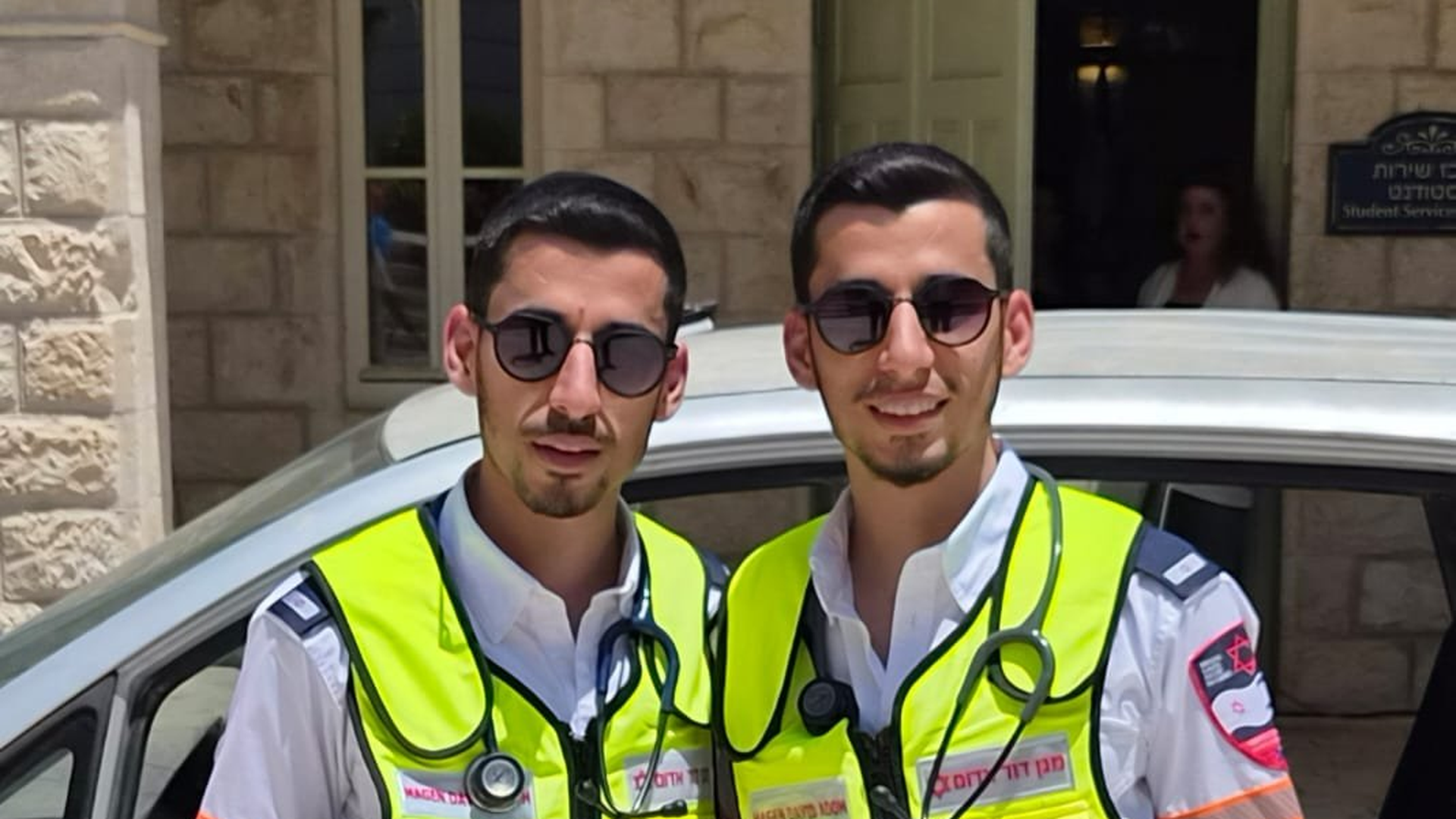
For as long as twin brothers Daniel and Tzuriel Maloch can remember, they wanted to work in the healthcare profession. “When we were little kids, we’d dress up for Purim as doctors with stethoscopes and white scrubs,” Daniel recalls. “Our idea of a hero was someone able to save lives.” Their dream only grew stronger when, as adolescents, an ambulance station was built not far from their home in the small town of Avniel. “We were close enough to see paramedics jumping inside the ambulance and driving off on calls,” Tzuriel says. “It was inspiring, how they were racing off to the scene of a crisis. That was how we decided we wanted to work in emergency medicine.”
Yet as members of Israel’s Haredi (ultra-Orthodox) community, the prospect of becoming a paramedic felt like “wanting to be a professional basketball player, or even an astronaut,” Tzuriel says. “In our yeshivot, we didn’t learn any secular subjects—no math, no biology, no English. There didn’t seem to be a path from our world to the world of medicine.”
When they were seventeen, however, they discovered an opportunity: a local Magen David Adom (MADA) course to train teenage medics. The Maloch brothers—“thanks to the support of our mother,” they insist, “who always encouraged our interest in learning new things”—signed up, and within the year were riding along on calls as MADA volunteers. When the experience proved every bit as fulfilling as they imagined it would be, Daniel and Tzuriel determined to take it a step further and pursue an academic degree.
“When you love a subject as much as we did,” says Daniel, “it only made sense to learn it as deeply and as seriously as we could.” Having set their sights on a bachelor’s in emergency medicine, they then set out to earn a high-school diploma—which was no easy feat. Even after completing a year of remedial studies in Jerusalem, “the gap was still too large. We were starting from zero in terms of secular knowledge, and we began to doubt our ability to learn at the college level. We were lacking a foundation,” he concludes, “and we need a place that could give us one.”
That place turned out to be Zefat Academic College (ZAC), where the brothers began learning in its year-long program for completing high-school matriculation requirements. “From the beginning, it was an amazing experience,” Tzuriel says. “Thanks to the support of the program’s teaching staff, we came to believe in our ability to make up any distance.” It was a belief they would need: Given their educational background, Daniel and Tzuriel were initially placed in the lowest mathematics track. To apply for college’s emergency-medicine degree, however, they would need to be in the highest track—and earn top scores in that track, to boot.
“We explained to the head of the program what we wanted to do,” says Daniel, “and we assured him that if he gave us a chance, he wouldn’t regret it. The fact that we’re paramedics today is thanks in large part to the college’s view of its students as people with potential, and not merely on a number on a page.”
After finishing at the top of their mathematics class—“For us,” Tzuriel jokes, “it wasn’t just a decisive test, but also the first time we’d ever take a standardized test before!”—they were accepted to their dream degree at ZAC. And as Daniel is quick to point out, the real challenge began there.
“We were the only Haredim in our program,” he says. “We were surrounded incredibly skilled individuals who had accomplished so much by that time, in the army, at jobs afterwards. We definitely felt out of our league.” That feeling increased when they started their courses in statistics and physics, which they both agree were the hardest subjects they’d yet to study. By the end of their first year, however, “we’d developed friendships with our fellow students that we know will last a lifetime,” Daniel says. “Arabs, secular Jews, it didn’t matter. We were all part of something larger. We were all there to learn how to save lives.”
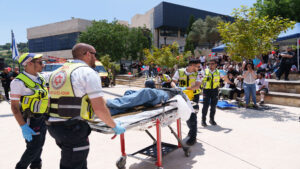
And today, as full-fledged paramedics for MADA, they do, racing off on calls throughout the day like the men they watched from affair as kids. They also work as teaching assistants at the college, helping train the next generation of paramedics for the Galilee. Which is how Tzuriel received proof that his chosen profession is having the impact he always sought.
“Last year, I was the first responder at the scene of a devastating car accident,” he recalls. “There were five seriously injured people, including a mother and her young daughter. All my training came to the fore in those first moments, when what I did could make the difference between someone surviving or not.” After treating everyone at the scene, Tzuriel brought his patients to the hospital—and wondered what happened to them ever since.
“Recently, during one of my teaching sessions, a student asked a question about a multiple-casualty situation, and I used the example of that car accident in my answer,” he says. “Another student said that she knew which accident I meant: She was friends with the family whose mother and daughter I’d treated, and she told me that both were doing great.
“It was an incredible feeling,” he concludes. “Being able to save someone’s life is a privilege. It makes the long road that we’ve both come to get here worth every step.”