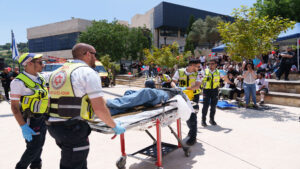

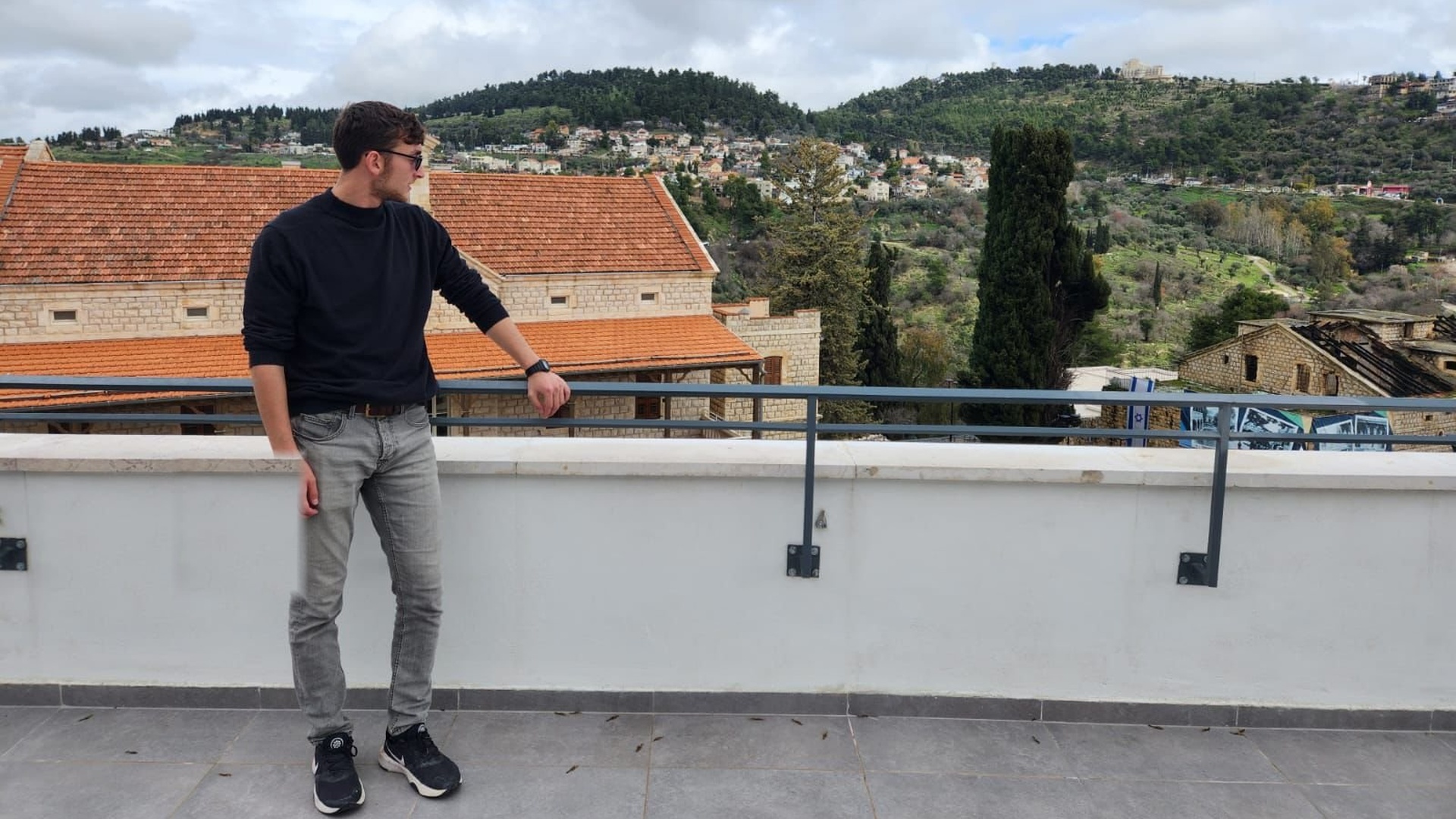
During a basic training exercise shortly after he joined the IDF, lone soldier Yehezkel Z. had to pretend to be a casualty victim in need of medical evacuation. “I kept calling out ‘hashiru,’ but no one seemed to know what I meant,” recalls Yehezkel, who had moved to Israel from his native Buenos Aires just a few months before. “Finally, when the exercise was over, another soldier asked me what I was saying. I started to explain, and he laughed and said, ‘It’s hatzilu.’ Thankfully, that’s one of those moments I can look back and laugh at now.”
For Yehezkel, 25, moving to Israel upon his graduation from high school was the fulfillment of a lifelong dream. Insisting that he “always felt that Israel was my home, and that I shared the same responsibility to protect my homeland as any Jew born here,” Yehezkel was thrilled when the army offered him the challenging role of combat medic. After completing his mandatory service—for which he received recognition for exceptional performance—he determined to leverage his experience into an emergency-medicine degree.
That’s when Yehezkel ran into his second biggest challenge: not language, but bureaucracy.
“There are very few places in Israel that offer a bachelor’s in emergency medicine,” explains Yehezkel, “and most wouldn’t accept my high-school diploma because it’s from a developing country. They said I’d have to first complete an academic preparatory course, which would have set me back another year.” Fortunately, Yehezkel discovered that Zefat Academic College (ZAC) offered the same degree—and that they were willing to find a way for him to start that same semester.
And it’s a good thing he did, Yehezel points out. One year later, when Hamas attacked Israel on October 7th, he was called upon to use his emergency-medicine training, this time in the reserves. For nearly a full year, Yehezkel first evacuated injured soldiers from the Gaza border, providing treatment during the transition from field to hospital; later, he was embedded as a combat medic with a battalion in Lebanon, responsible for providing immediate, life-saving care on the battlefield.
“Thanks to what I’d learned at Zefat,” says Yehezkel. “I was able to be a much better paramedic. In all our courses, the instructors taught us how to do things in an orderly way, even under the messiest of circumstances.” Yehezkel explains that he had numerous opportunities to put those lessons to the test, such as the time he had to treat a life-threatening injury under the worst possible conditions.
“It was late at night in Lebanon, and the weather was awful,” he recalls. “It was incredibly foggy, and there the air was full of dust. I was also wearing very heavy equipment that made it hard to move around. If not for having trained for just these sorts of scenarios, I’m not sure I could have managed treatment. In those situations,” Yehezkel concludes, “you act on muscle memory, and thankfully the knowledge was there.”
Yehezkel also stresses that beyond the academic training, ZAC gave him something no less important: a supportive community. From one-on-one tutoring to catch up on coursework he missed while he was in the reserves to arranging for exams—“literally with just a day’s notice”—when he was granted leave, ZAC faculty and staff “went above and beyond” to ensure that Yehezkel could maintain his academic dreams. “Everyone at the college was in sync with everyone else,” says Yehezkel. “I would make one phone call or send one WhatsApp, and the entire college administration was coordinating how best to meet my needs.
Currently in his final year of studies, Yehezkel plans next to apply to a four-year medical school. (“There are requirements I’ll need to take first,” he explains, “but luckily, Zefat offers a medical preparatory program.”) He also wants to be a paramedic in the reserves, which will enable him to offer more advanced treatment to soldiers in the field.
“To me, every soldier I treat is a brother,” says Yehezkel. “Even after I’ve delivered him to the ambulance or helicopter, I think about him constantly and pray for his recovery. I’m grateful that Zefat College gave me the ability to help him at the critical moment, when his life depended on it.”